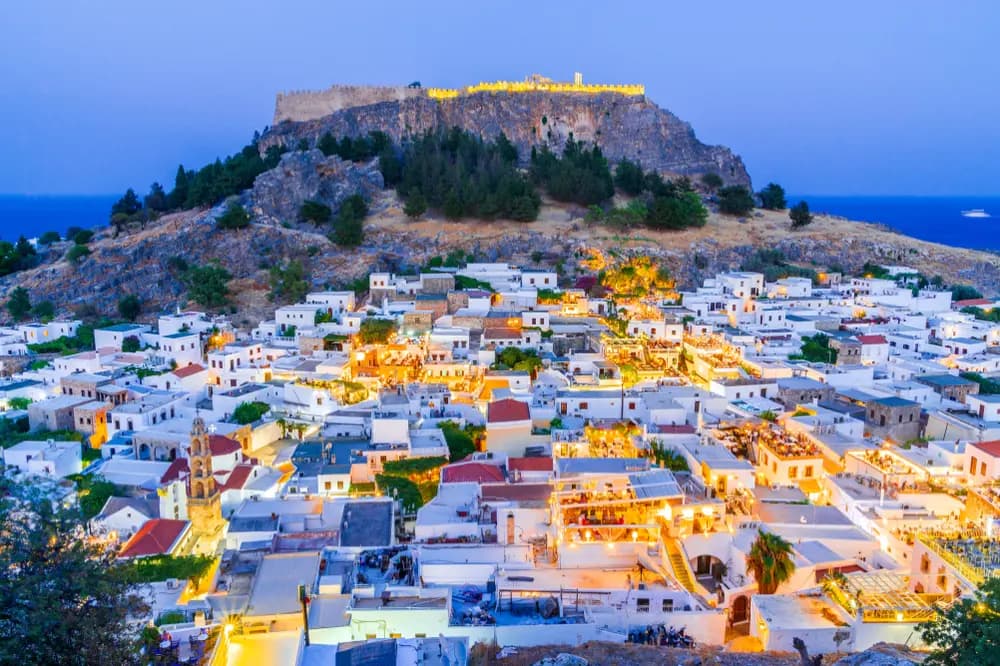
Rhodes
Rhodes, the largest of the Dodecanese islands, is a holiday destination in its own right: the medieval City of the Knights, a UNESCO World Heritage Site, the Acropolis of Lindos to the south and long sandy beaches all come together on the same island. Reachable by ferry from Fethiye, Rhodes is one of the Aegean’s most vibrant islands for those seeking a blend of history, beaches and lively town life.
Search ferries to this island
Beaches
The east coast of Rhodes is known for its long sandy beaches. Tsambika, with its wide sandy stretch at the foot of the monastery, is one of the most popular beaches; just to the north, Anthony Quinn Bay takes its name from the lead actor in the film ‘Zorba’ and, with its rocky shores and crystal-clear waters, is ideal for snorkelling.
Prasonisi, at the southernmost tip of the island, consists of a narrow strip of sand where the Aegean and the Mediterranean meet; depending on the season, it is sometimes a peninsula and sometimes an islet, and is a favourite spot for surfers thanks to its strong winds. The west coast is generally windier, whilst the east coast is calmer for swimming.
The beach just below Lindos offers a unique experience for those wishing to swim whilst enjoying views of the acropolis. Most of the beaches can be reached by car or on the summer bus routes.
History and Culture
The heart of Rhodes is its walled medieval Old Town — one of Europe’s best-preserved medieval centres and a UNESCO World Heritage Site. Rising at the top of Knights’ Street, the Grand Master’s Palace dates back to the era of the Knights of St John; it was used as a fortress and command centre and is now a museum.
In the south of the island, the Lindos Acropolis, perched on the rocky outcrop above the village of Lindos, is one of Greece’s most impressive ancient sites, with the Temple of Athena Lindia situated at the top of a 116-metre cliff. The whitewashed village of Lindos and the cove below are usually visited together with the acropolis.
Rhodes was also home to the Colossus of Rhodes, one of the Seven Wonders of the Ancient World; the giant bronze statue was destroyed in an earthquake in the 3rd century BC and no longer stands today, but it is remembered as a symbol of the island’s ancient splendour.
What to Do
Getting lost in the cobbled streets of the Old Town is enough to fill a whole day: Knights’ Street, the inns, the gates and a walk along the ramparts. In the evenings, the town’s taverns and courtyards come to life.
Set aside a full day for Lindos — the acropolis, the village and the bay all in one. As the island is quite large, it’s a pleasure to drive along the east coast (Kallithea, Faliraki, Tsambika) and visit the beaches one by one.
Prasonisi is a hub for windsurfing enthusiasts; Rhodes is also worth exploring for its inland villages and natural attractions such as Seven Springs (Epta Piges).
Best Time to Visit & Getting There
Ferries to Rhodes operate during the tourist season, which generally runs from April to October. Summers are hot and crowded; spring and autumn are ideal for both the weather and a comfortable visit. The crossing from Fethiye takes approximately 90 minutes to 2 hours, depending on the type of ferry.
Rhodes is a large island; the Old Town is within walking distance, but it’s quite a long way to Lindos and the southern beaches. The most flexible option is to hire a car — you can book both the ferry and the car together via TravelBeez.